Visual Authenticity
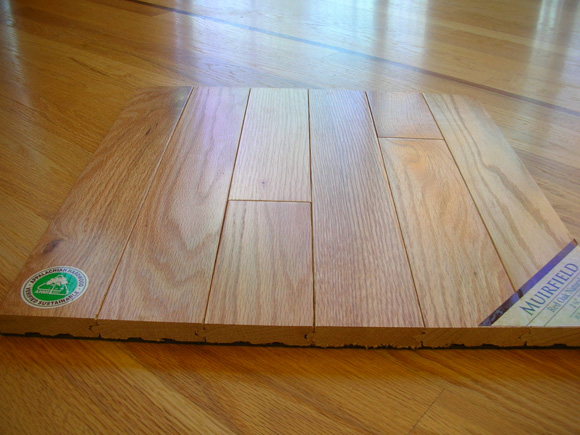
Some brands of engineered wood flooring use one wide plank of flooring to simulate several narrower planks. What is referred to as a "1-strip piece" will be a single plank that is a single strip. A "2-strip piece" will be a single plank made to look like two strips, etc. If the product has microbevels, this is very noticeable. If it is smooth, the seams are still visible, but less noticeable.
Transitions
If you are putting new wood flooring next to existing wood flooring, the thickness of the materials may differ, especially between engineered and older wood flooring. If you do not want to have a height difference between two areas, you will either have to have a transition (such as a stained door sill) or build up the subfloor underneath the new flooring to match the height. If your primary motivation was saving money, this added expense should be factored into your decision.
Maintenance
Pre-finished has an aluminum oxide finish that cannot be site-finished and does not have a real "clear finish" due to the aluminum suspended in the finish. If you have large pets with claws, lots of animals, heavy traffic, routinely wear shoes in the house, or are generally hard on your floor, this should not be your first choice.
Engineered allows you to sand and refinish the floor, but how many times depends on the thickness of the wear layer. Look for the thickest wear layer available. There are companies that have wear layers nearly as thick as solid wood flooring. Owens has a line with a 5mm (approx. 3/16") wear layer. For comparison, 3/4" solid flooring has a 5/16" wear layer above the tongue and groove. This is the amount that is sandable, however you cannot sand all the way down to the tongue and groove without splintering and exposing nails. So, in reality, a 3/4" solid product has about a 6mm (1/4") wear layer which is just about equal to the Owens 5mm wear layer (which can be sanded until there is no wear layer left).
Wear layer of solid unfinished oak vs. engineered unfinished oak